Chapter 8: Tools & Accessories
Complete accessories checklist, installation tools, and consumables for underground parking surveillance systems
8.1 Accessory List
The accessories checklist covers all physical components required for a complete underground parking surveillance installation, organized by category from camera mounting hardware through documentation and spare parts. Every item marked as critical must be verified on-site before camera installation begins. Substituting non-specified accessories — particularly waterproof junction boxes, cable glands, and surge protection devices — is the most common cause of early-life field failures in underground environments.
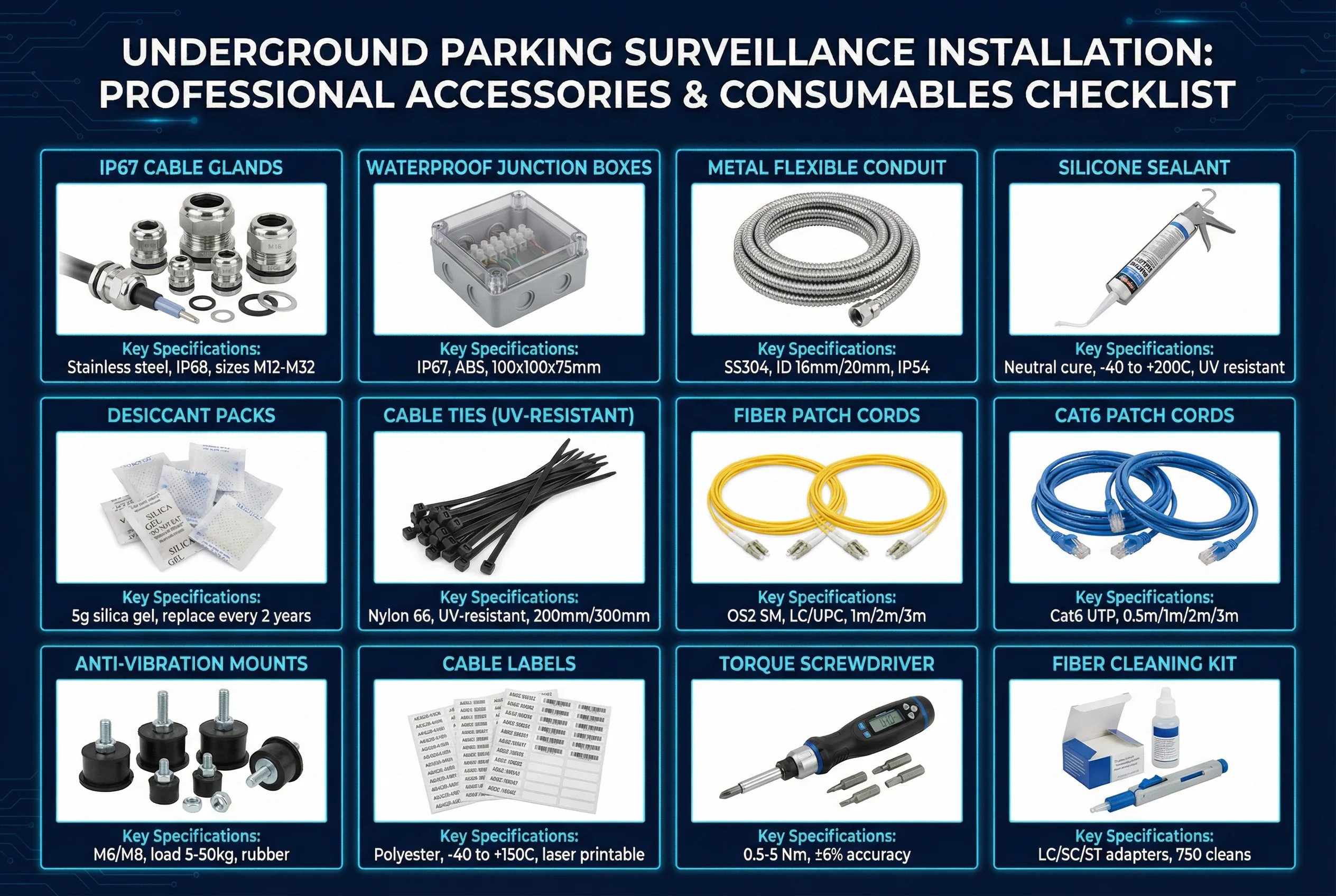
Figure 8.1: Complete Accessories & Tools Checklist — All Items with Specifications, Quantities, and Critical Status for Underground Parking Surveillance Installation
| Product Name | Description | Specification | Use Case | Selection Tips | Poor Quality Risk | Check Method |
|---|---|---|---|---|---|---|
| Waterproof Junction Box | Sealed camera cable termination enclosure | IP66/67; stainless screws; multiple gland ports | Protect all camera cable terminations from moisture | Verify gasket quality and box volume for cable management | Water ingress → connector corrosion → link failure | Visual inspection + water drip simulation test |
| IP67 Cable Gland | Sealed cable entry fitting for conduit/box | M20/M25; match cable OD precisely; neoprene seal | Seal cable entry points in junction boxes and cabinets | Measure cable OD before ordering; oversized glands leak | Moisture ingress even with IP67-rated box | Torque to spec; inspect seal compression |
| Metal Flexible Conduit | Armored flexible conduit for camera tail protection | 16–25mm; corrosion-resistant; liquid-tight | Protect camera cable from vandalism and mechanical damage | Use corrosion-resistant type in wet environments | Cable cut by vandalism; corrosion in humid zones | Bend test; inspect fittings for seal integrity |
| Anti-Tamper Screws | Security fasteners for camera and box mounting | Torx T20 or Tri-wing; matching driver required | Prevent unauthorized removal of cameras and junction boxes | Use consistent screw type across all cameras for one driver | Standard screwdriver allows easy vandal removal | Verify screw type; confirm standard driver cannot engage |
| Cable Labels / Heat-Shrink | Durable identification labels for all cables | Oil/water resistant; adhesive-lined heat-shrink type | Identify cables at both ends for O&M and troubleshooting | Use zone + camera ID format; apply before pulling cable | Label falls off → miswiring during repair → extended outage | Pull test; readability check after 30 days |
8.2 Installation Tools
The following installation tools are required for a complete underground parking surveillance deployment. Each tool has a defined use case, key performance parameters, and a documented misuse risk. Tool misuse — particularly using a cable tester in the wrong mode or taking fiber power measurements without a proper reference — is a common cause of acceptance test failures that are only discovered after commissioning, requiring expensive rework.
| Tool | Description | Use Case | Key Parameters | Misuse Risk | Phase |
|---|---|---|---|---|---|
| Cable Tester (PoE) | Verifies cable pairs, PoE class, and link speed | Validate all Cat6 runs before camera connection | Cat6 certification level; PoE class detection; TDR length | False pass if wrong test mode; misses marginal pairs | Installation + Acceptance |
| Fiber Optical Power Meter | Measures optical insertion loss on fiber links | Validate all fiber uplinks after splicing and connectorization | Wavelength 1310nm/1550nm; reference measurement required | Wrong reference → incorrect loss reading; pass/fail error | Commissioning |
| Torque Screwdriver | Calibrated tightening for glands and terminals | Tighten cable glands and terminal blocks to specified torque | Nm range matching gland/terminal spec; calibration certificate | Over-tightening cracks gland seal; under-tightening allows leakage | Installation |
| Thermal Imaging Camera | Infrared camera for hotspot detection | Scan cabinets and connections under load for overheating | Temperature range 0–150°C; resolution ≥160×120; emissivity adjustment | Misinterpret reflections as hotspots; miss hotspots on shiny surfaces | Acceptance + O&M |
| Lux Meter | Measures ambient illumination at camera positions | Verify minimum illumination levels for camera selection validation | Range 0–100,000 lux; cosine-corrected sensor | Measurement at wrong angle gives misleading result | Design + Installation |
| Ladder / Elevated Work Platform | Safe access to ceiling and beam mounting positions | Camera mounting, cable routing, and inspection at height | Rated load ≥150kg; non-conductive; anti-slip feet | Fall hazard; tip-over on uneven parking floor surface | Installation |
8.3 Consumables
Consumables are the lowest-cost items in a surveillance installation but are responsible for a disproportionate share of field failures when low-quality alternatives are used. Silicone sealant that uses acid-cure chemistry corrodes camera connectors; cable ties that are not UV-resistant become brittle and break; desiccant packs that are not replaced on schedule allow moisture to accumulate inside junction boxes. The following table defines the minimum specification and recommended practice for each consumable category.
| Consumable | Description | Specification | Use Case | Why Quality Matters | Poor Quality Risk | Recommended Practice | Check Method |
|---|---|---|---|---|---|---|---|
| Silicone Sealant | RTV silicone for waterproof sealing | Neutral cure (not acid cure); -40°C to +200°C | Seal junction box covers, conduit entries, and cable penetrations | Acid-cure type releases acetic acid which corrodes copper connectors | Connector corrosion → intermittent link → recording gaps | Apply to clean, dry surfaces; allow full cure before water exposure | Cure inspection after 24h; pull test on sealed joint |
| Cable Ties | Nylon fasteners for cable management | UV/oil resistant nylon; 200mm minimum; rated load ≥18kg | Bundle and secure cables in conduits and cabinets | UV-resistant type prevents brittleness in areas with occasional light exposure | Brittle ties break → cable sag → strain on connectors → intermittent link | Add slack loops; do not over-tighten on fiber cables; use velcro for fiber | Pull test; inspect for brittleness after 12 months |
| Desiccant Packs | Silica gel moisture absorber | Replaceable type with color indicator; 5–10g per junction box | Absorb residual moisture inside sealed junction boxes and cabinets | Prevents condensation on connectors in humid underground environments | Saturated desiccant is useless; moisture accumulates → fogging → corrosion | Schedule replacement every 6–12 months; check indicator color at each inspection | Weight check; color indicator inspection; replace if indicator changed |
| Heat-Shrink Tube (Adhesive-Lined) | Dual-wall heat-shrink for insulation and identification | Adhesive-lined; 3:1 shrink ratio; oil/water resistant | Insulate and label cable terminations and splice points | Adhesive lining creates waterproof seal at termination; single-wall type does not | Poor adhesion → moisture ingress at termination → corrosion | Use adhesive-lined type for all outdoor and wet-area terminations | Visual inspection; tug test on shrunk tube |